 StardewValleyZone
In the digital realm of 2026, there exists a peculiar breed of interactive experiences that defy the very notion of a quick session. They are not mere distractions, but gravitational wells of engagement, where a promise of a few minutes spirals into a journey where the rising sun becomes an unintended checkpoint. These are the worlds where "just one more turn" evolves from a casual phrase into a whispered mantra, a siren's call that lures players into a state of flow so profound that time itself seems to dissolve. Whether it's the meticulous planning of a tactical maneuver, the desperate push through one more procedurally generated floor, or the completion of a seemingly simple seasonal task, these games possess a hypnotic momentum. They are not necessarily the most punishing in difficulty or the most epic in length, but they are, perhaps, the most insidious in their ability to warp a player's perception of a brief escape into an accidental all-nighter.
The Clockwork Tension: XCOM 2
The notion of a relaxing strategy game is a foreign concept within the high-stakes theater of XCOM 2. Here, every single turn is a high-wire act, a delicate operation akin to defusing a volatile explosive while deprived of sight and under the harsh scrutiny of an extraterrestrial commander. Its addictiveness is born not from comfort, but from a relentless, nerve-shredding pressure. The player becomes ensnared, unable to disengage because the squad is too committed, the mission too critical. One more turn could be the salvation of a cherished sniper. One more turn might secure the evacuation. One more turn could finally see the fickle whims of chance align in their favor. The game's sublime, yet cruel, beauty lies in its interlocking systems, each wound as tightly as the springs of a timepiece perpetually on the verge of catastrophic failure. Meticulous resource allocation, sprawling tech trees, and custom squad loadouts—all these grand plans can be rendered meaningless by a single, disastrous flanking maneuver that dooms an entire campaign. Paradoxically, it is this ever-present specter of failure, this exquisite tension, that compels players to restart time and again, each new attempt fueled by the unshakable conviction that this time, perfection is within reach. The cycle is perpetual.
The Euphoric Dance: Dead Cells
Just as a player's resolve to stop solidifies, Dead Cells unveils another tantalizing fragment of possibility. A new weapon blueprint glimmers in the darkness, a hidden passage whispers of secrets, a cursed chest dares to be opened, or an entirely new biome beckons from the map. The true mastery of its design is that victory over the final boss is not the sole hook; the simple, tangible act of performing better than the previous attempt is enough. There is a raw, tactile joy in every motion: the fluid dodge roll, the perfectly timed parry, the swift ascent up a wall. Movement itself feels like a reward, and the combat's snappy responsiveness ensures each mistake is perceived as a fair lesson rather than a cheap defeat. However, the true anchor is the game's masterful trail of incremental progression. Even a failed run is never truly wasted. Cells are banked for future unlocks. Permanent runes are discovered, granting access to new areas. And on those glorious, rare occasions when every element synchronizes—when reflexes are sharp, builds are synergistic, and luck is a gentle ally—the resulting rush is a state of borderline euphoria. In such a moment, the question of stopping becomes absurd.
The Tactical Spiral: Slay the Spire
What begins as a modest ascent of a mysterious, pixelated tower rapidly metastasizes into a multi-hour obsession with optimization and collection in Slay the Spire. Players with a tactical bent find themselves trapped in a mesmerizing loop: meticulously rerouting their path on the map to secure optimal relics, constantly tweaking and refining their deck mid-climb, all while praying their fragile, card-based strategy doesn't shatter in the next encounter with a powerful elite foe. The core of its temporal distortion is deceptively simple: a single, successful run might last only 40 minutes. But a victory unlocks new cards. These new cards fundamentally alter the strategic landscape. New, powerful synergies emerge from the expanded pool. Suddenly, a session intended as a brief lunch break has spiraled into an entire evening dedicated to constructing, testing, and reconstructing decks until, perhaps, a perfect, poison-focused build for The Silent character finally clicks into place. And the moment that victory is achieved, the siren call of the Ironclad's bruising style begins anew.
The Grand Deceiver: Civilization VI
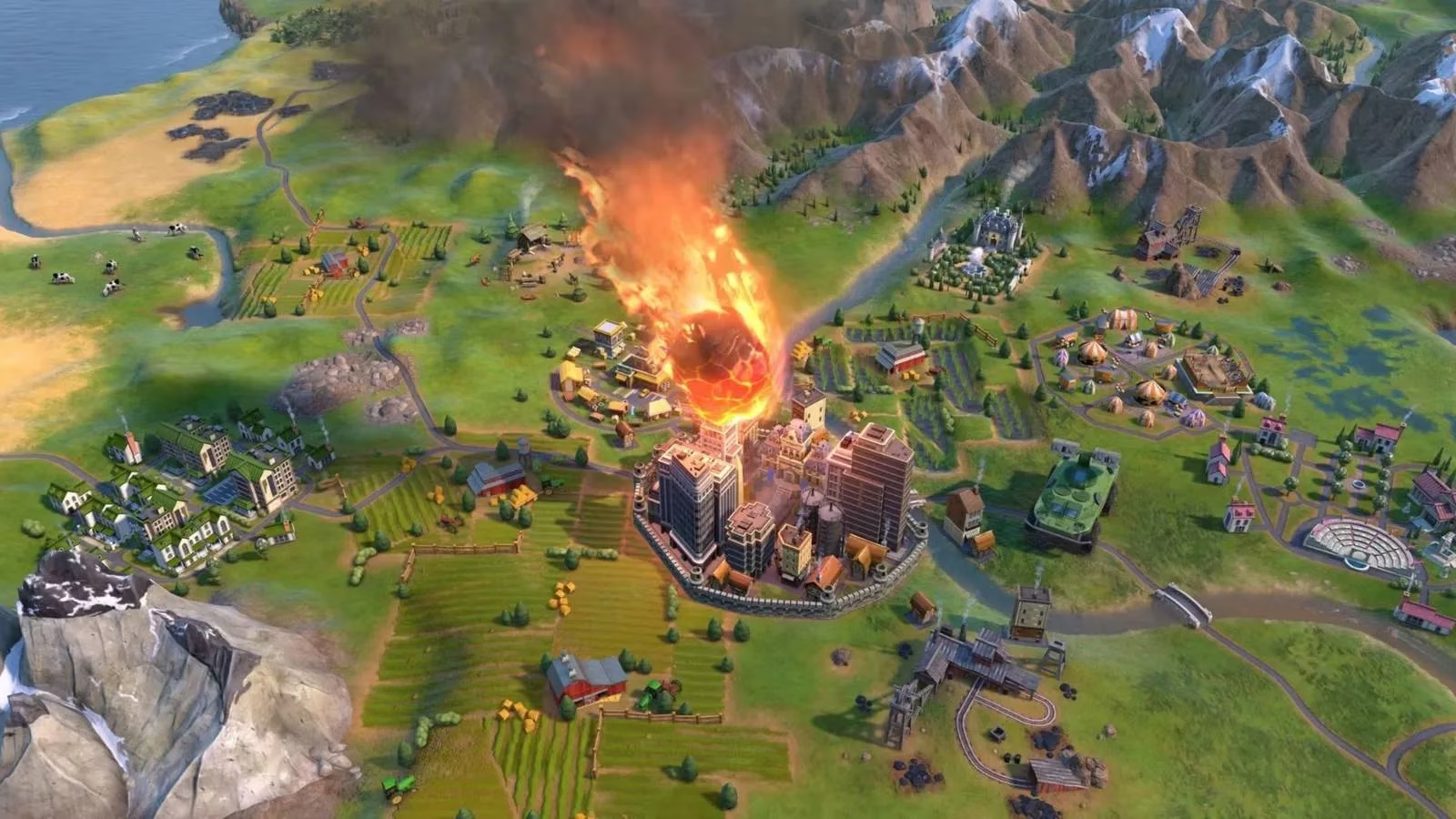
In the pantheon of "one more turn" experiences, Civilization VI stands as the archetype, the original architect of stolen time, a benevolent demon in strategy-game clothing. The chain reaction is legendary: one turn to secure a science boost leads to unlocking advanced artillery, which precipitates a full-scale, surprise war with a nuclear-armed Gandhi, and before rational thought can intervene, it is 3 a.m. and the player is engaged in a frantic race against Brazil for a cultural victory while simultaneously quelling a rebellion in Amsterdam. Its genuine danger stems from its masterful, slow-burn cadence. A complete match can span dozens of hours, yet each individual turn feels like a precisely measured dose of strategic dopamine. The user interface is designed to constantly suggest imminent importance—a notification here, a resource tick there—maintaining a low hum of anticipation even during peaceful stretches. And when a genuine, game-altering event does occur? That commitment instantly expands by a minimum of a hundred more turns. It is a masterclass in perpetual engagement.
The Cozy Cultivation: Stardew Valley
Any soul who has uttered the phrase "just one more day" before logging out of Stardew Valley has willingly participated in a gentle, self-aware deception. The game is the purest distillation of cozy addiction. Each new dawn on the farm presents a fresh tapestry of micro-objectives: a new crop to plant, a task on the community center bulletin board, a heart event with a townsfolk waiting to unfold. Without warning, players find they have meticulously planned and executed three in-game weeks, driven by the simple desire to see if a specific, elusive blue chicken will finally make an appearance. Its brilliance is in the organic, sprawling nature of its goals. The simple aim of upgrading a watering can casually necessitates a delve into the mines for ore, which leads to the pursuit of rare iridium, which involves befriending a reclusive wizard, and somehow culminates in marrying a melancholic musician and constructing a teleportation obelisk. It is a heartwarming, wholesome world, yet the relentless loop of small, satisfying accomplishments binds players to their pastoral plots with the quiet dedication of managing a rural, benevolent cult of productivity and connection.
The Chaotic Crescendo: Risk of Rain 2
There is a beautifully chaotic, unpredictable energy to Risk of Rain 2 that makes disengagement an impossibility once the snowball begins to roll. It is the embodiment of exponential escalation. A run might commence with a humble character, a basic weapon, and a couple of simple helper drones. A few treasure chests and stages later, the sky is raining seeking missiles, ability cooldowns have vanished, and the screen is an overwhelming, glorious spectacle reminiscent of a chaotic fireworks display. Yet, the hook is not solely the dopamine surge of stacking countless powerful items. It is the silent, ever-climbing difficulty timer—a constant, taunting companion that dares the player to stay just a little bit longer. The longer they survive, the more absurdly potent they become, but the enemies grow correspondingly more fierce and numerous. The game never explicitly commands a halt. Instead, it silently, masterfully, tempts players to push their burgeoning power and luck to the absolute limit, often until the entire glorious, overpowered edifice collapses in an instant from a single misstep. And in the quiet aftermath of that spectacular collapse, the idea of starting just one more run doesn't just sound good—it feels like an imperative.
Data referenced from ESRB underscores how these “one more run/turn/day” time-sinks span very different intensity levels—turn-based strategy pressure (XCOM 2), high-speed roguelike loops (Dead Cells, Risk of Rain 2), and cozy routine compulsion (Stardew Valley)—yet can all sit comfortably within ratings that signal their content themes and player-facing expectations before you commit to an all-night session.